
New engine, old factory
The 5% of companies seeing real returns from AI spend 70% of their effort on process redesign and organisational change, not on the technology. Everyone else is repeating the same mistake factories made when they swapped steam engines for electric motors but kept the old floor plan.
In 1987, Robert Solow observed that "you can see the computer age everywhere but in the productivity statistics." The line became one of the most cited in economics. Nearly four decades later, it describes AI perfectly.
374 S&P 500 companies mentioned AI on their earnings calls last year. Only 1% quantified its impact on actual earnings. S&P Global found that 42% of companies scrapped the majority of their AI initiatives in 2025, up from 17% the year prior. At the task level, the technology works: individual productivity improvements of 14–55% across studies. At the organisational level, the gains vanish. The gap between what individuals achieve and what organisations capture is the entire story.
The dynamo problem
Economist Paul David answered this in 1990, three decades before anyone was thinking about large language models. His paper "The Dynamo and the Computer" examined why electrification took over 30 years to produce measurable factory productivity gains. The answer was not the technology. It was the factory.
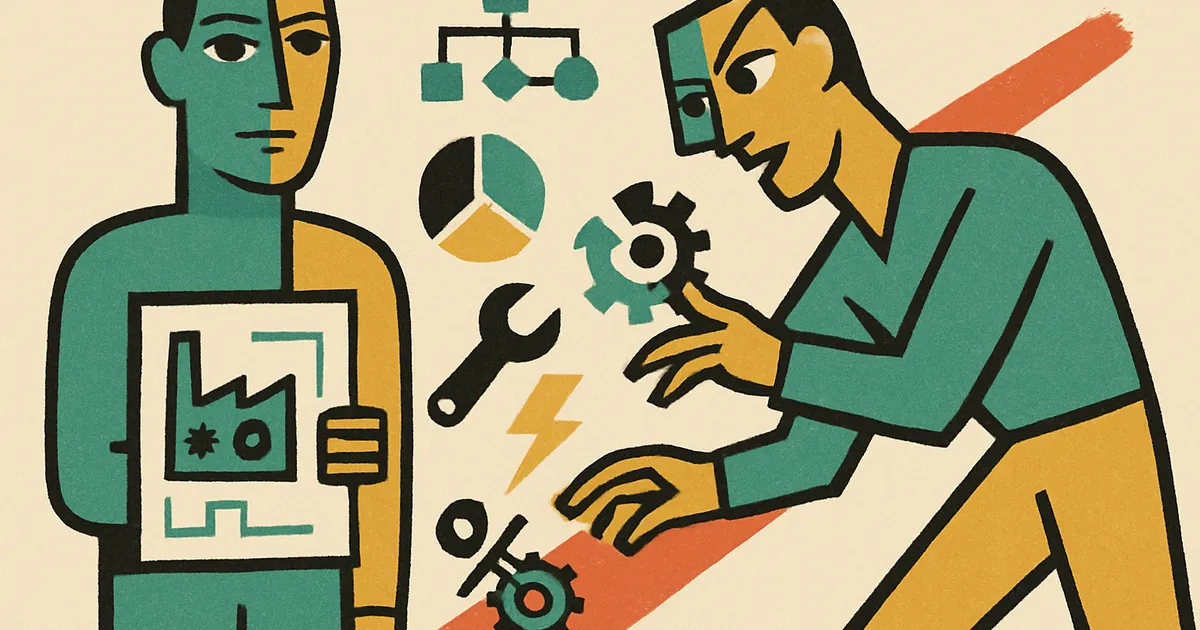
Early factory managers swapped their steam engines for electric motors and changed nothing else. Same belt-and-pulley layouts. Same floor plans designed around a single central power source. Same work organisation. They put a new engine in an old factory and wondered why output barely moved.
The productivity explosion only arrived in the 1920s, when a new generation of managers redesigned factories from scratch around what electric motors actually made possible: distributed power. Instead of routing everything through a central shaft, they could place small motors at each workstation. This enabled layouts based on workflow rather than power transmission: single-storey buildings, assembly lines, flexible configurations. The technology hadn't changed. The organisation finally had.
Erik Brynjolfsson formalised this pattern as the productivity J-curve: general-purpose technologies require co-invention of new processes, business models, and human capital before their benefits appear in output statistics. His 2025 Census Bureau research confirmed the pattern holds for AI. Early adopters experience short-term productivity and profitability losses before longer-term gains. Firms that adopted before 2017 show stronger growth, conditional on survival.
That qualifier is doing significant work. The J-curve is real, but not everyone makes it through the dip.
Where the effort actually goes
The organisations navigating the J-curve successfully share a specific effort distribution. BCG's research on top AI performers found they dedicate 10% of their effort to algorithms, 20% to data and technology, and 70% to people, processes, and cultural transformation.
Seventy percent on the human side. Almost nobody talks about this.
Most organisations invert that ratio. They spend on models and infrastructure, treat process change as a footnote, and wonder why the returns are thin. McKinsey's state of AI report puts a number on it: 95% of enterprise generative AI pilots deliver no measurable profit-and-loss impact. Not because the models are inadequate. Because the organisations are not ready to use them at scale. The models work. The factories haven't been redesigned.
Bolt-on versus redesign
The case studies split into two categories, and the outcomes are not subtle.
Klarna automated its customer service without rethinking what customer service needed to be. The AI handled volume; it could not handle the complexity and emotional nuance that human agents had been quietly absorbing. By mid-2025, the company was rehiring. The existing process was automated without questioning whether that process should exist in its current form.
Contrast this with organisations that redesigned first.
JPMorgan's COiN platform rethought legal document review from the ground up: 12,000 documents processed in seconds versus weeks, roughly 360,000 legal work hours saved annually, compliance errors down approximately 80%. They did not add AI to the existing review process. They rethought what document review should look like when machine reading is a given.
Markel Insurance partnered with Cytora to transform its underwriting workflow, not merely automate the old one. The outcome was a 113% increase in underwriter productivity and quote turnaround cut from 24 hours to 2 hours. Haven Life redesigned the entire life insurance application around AI-driven underwriting, issuing policies in 20 minutes rather than the traditional weeks.
The pattern
The pattern across every successful case is identical:
- They did not layer AI on top of the existing workflow
- They identified which steps existed only because a human was performing the work
- They eliminated those steps entirely
- They created new roles for human judgement and exception handling
- They built the process around what AI actually does well
Companies that skip the redesign step get incremental improvement at best. At worst, they codify dysfunction into software logic, accelerating chaos rather than improving output. Automating a mess gives you a faster mess.
This is not a technology problem. It is an organisational design problem. Product engineers see it constantly: the tool works fine, the process around it is broken. The same reason CRM implementations fail. The same reason ERP rollouts go sideways. The bottleneck is never the software.
The factory floor, not the engine
The uncomfortable truth for business leaders: the bottleneck is not the model, the data, or the budget. It is the willingness to treat AI adoption as organisational transformation.
Paul David's factory managers had the right technology for 30 years before anyone got the organisation right. The ones who eventually captured the productivity gains were not the ones with better motors. They were the ones willing to demolish the factory and rebuild it around new principles. That required a different kind of leadership, one comfortable with the idea that the existing way of working was not a constraint to optimise around but an obstacle to remove.
Brynjolfsson's J-curve suggests that AI's broad productivity impact may not materialise for years. The firms that adopted early and survived the dip are already pulling ahead. But survival requires something most organisations struggle with: sustained investment in reorganisation during a period when the numbers look worse, not better. The J-curve demands that you keep redesigning while your board asks why the metrics haven't moved.
Every company says they are "AI-first." Almost none are willing to be "process-second," to actually kill the old workflow and build a new one from what the technology makes possible. That is the gap. Not capability. Willingness. And if the electrification parallel holds, the organisations that figure this out in the next few years will define the productivity norms for the next several decades. The rest will still be running belt-and-pulley factories with very expensive electric motors bolted on.