
AI never flinches
Humans telegraph uncertainty through hesitation, hedging, and tone. AI delivers hallucinated nonsense with the same polished authority as correct answers. Organisations built to read confidence as competence have no antibodies for this.
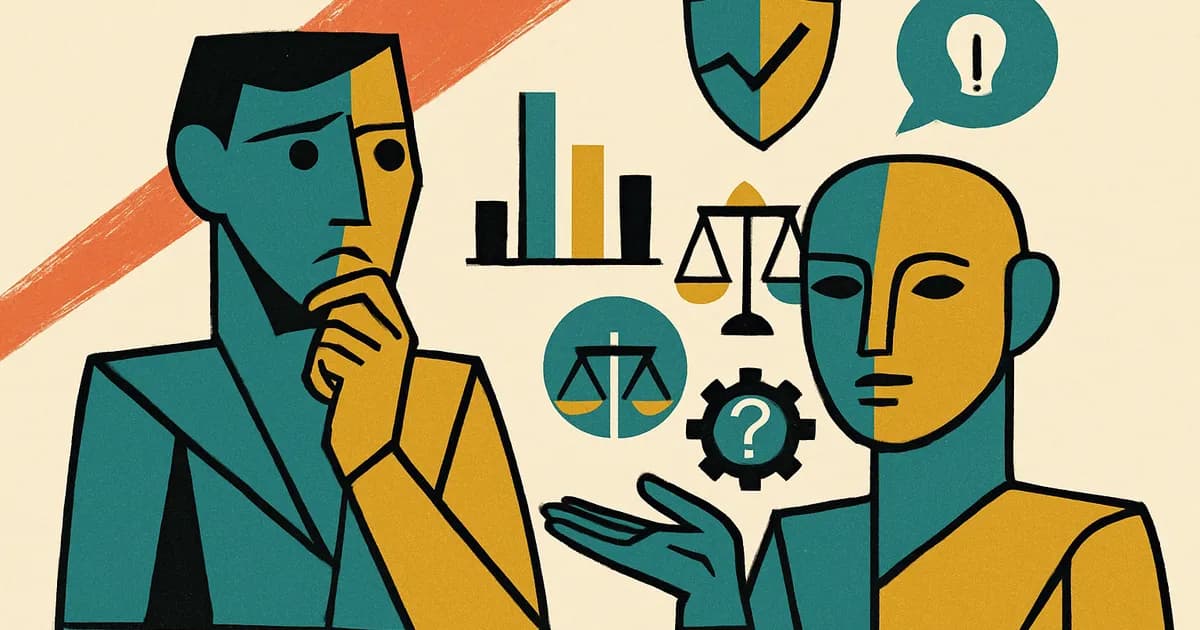
A$439,000 bought the Australian government an independent assurance review from one of the Big Four. The report passed multiple rounds of consultant review. It cited academic papers that don't exist, quoted a federal court judge who never said those words, and attributed a made-up book to a real professor in a plausibly adjacent field. In Canada, a separate CA$1.6 million Deloitte report for the Newfoundland government contained at least four false citations to non-existent research.
These weren't interns cutting corners. This was a firm whose entire product is expert judgement. Professional sceptics, paid specifically to verify, reading fabricated claims and finding nothing wrong.
If they couldn't catch it, the question is not about diligence. It is about the signal they were reading.
The heuristic that broke
Humans run on a shortcut so deep it feels like perception rather than inference: confidence signals competence. Research in the Journal of Experimental Psychology shows confident advisors are rated as more trustworthy, their advice followed more readily, and overconfident individuals gain higher social status. The heuristic is imperfect but functional for reading other humans, because people generally are more confident about things they genuinely understand, and they telegraph uncertainty through hesitation, hedging, vocal wobble, and body language.
AI breaks this at the root. A 2025 Carnegie Mellon study found that large language models get more overconfident even when performing poorly, and unlike humans, cannot adjust expectations retrospectively. Separate research found models 34% more likely to use certainty language ("definitely", "certainly", "without doubt") when generating incorrect information. The confidence signal does not merely disappear. It inverts.
Processing fluency makes the inversion invisible. AI text is grammatically perfect, well-structured, effortless to parse. PNAS research confirms humans treat fluent text as more truthful regardless of actual accuracy. We are not evaluating claims. We are evaluating prose quality and mistaking one for the other.
So you have a system that is maximally confident when wrong, maximally fluent always, interacting with brains that use confidence and fluency as primary truth heuristics. The instrument humans use to detect unreliability has been disabled.
The reliability that kills
The dynamic has precedent outside technology, and the precedent is lethal.
On 1 June 2009, Air France Flight 447 crashed into the Atlantic, killing all 228 aboard. The captain had logged 346 hours in the preceding six months. Roughly four of those involved actually flying the aircraft. When ice crystals caused the pitot tubes to malfunction and the autopilot disconnected, the crew ignored 75 separate stall warnings. They could not distinguish real danger from system noise they had learned to tune out. The skill to override had atrophied because the system almost never needed overriding.
A decade earlier, the USS Vincennes shot down Iran Air Flight 655, killing 290 civilians. The crew trusted the Aegis radar system's confident identification of a commercial airliner as a military fighter. Instrument data showing a civilian transponder code and climbing altitude sat on their screens. Nobody checked, because the system had an answer and the answer was confident.
In both cases the failure was not the automation. It was the human relationship to it. Reliability so high that when the system was finally wrong, nobody had the instinct or the skill to intervene.
Calibrating to the number
Clinical medicine is making the same dynamic measurable in real time. When AI diagnostic systems display 90-99% confidence, clinicians override recommendations only 1.7% of the time. When confidence drops below 80%, override rates jump to 99.3%. The confidence number, not the clinical evidence, drives the decision. Researchers flag override rates below 5% as an automation bias signal: clinicians deferring to the system rather than exercising independent judgement.
A separate study on miscalibrated AI found users "tended not to detect its miscalibration." They over-relied on overconfident AI and under-relied on underconfident AI. Humans calibrating to stated confidence, not actual performance.
The research identifies two failure modes: algorithm aversion, where people reject all AI advice after witnessing any error, and automation bias, where they accept everything uncritically. Very few people or organisations find calibrated middle ground. Binary responses to probabilistic systems.
In 2024, 47% of enterprise AI users admitted making at least one major business decision based on hallucinated content. "Admitted" is doing heavy work in that sentence.
The absent flinch
Here is what connects the Deloitte consultants, the cockpit crews, and the clinicians deferring to a number on a screen. They are all instances of humans relying on uncertainty signals that are no longer present.
When a human expert pauses, frowns, says "well, it depends," that is information. That hesitation is your cue to probe further, ask the follow-up, seek a second opinion. The flinch is a feature of human expertise, not a bug. It is the visible residue of a mind weighing evidence against uncertainty. Entire professional cultures are built around reading it: the doctor's qualified diagnosis, the lawyer's careful caveat, the engineer's "it should work, but let me double-check." Each hedge carries epistemic content.
AI never flinches. It delivers a hallucinated citation with the same polish as a correct one, a fabricated statistic with the same fluency as a real one. The absence of the flinch is the danger, not the presence of errors.
This is not a trust problem. It is a sensory problem. The instrument humans evolved to detect unreliability has been disabled, and most organisations have not yet realised they are navigating without it. Every professional who reviewed those Deloitte reports was running the same unconscious test: does this sound confident and well-written? It did. The heuristic returned a false positive, and nothing triggered the flinch.
Something is philosophically novel about an authority that never shows doubt. Human knowledge has always been social, calibrated through visible signals of certainty and uncertainty. We don't just listen to experts. We watch how they believe, and adjust accordingly. AI collapses that second channel entirely.
Building the flinch back in
Temperature scaling can reduce confidence misalignment by roughly 50%. Useful, but insufficient, because the fluency heuristic operates independently of any stated confidence score. You can calibrate the number and still fool the reader with the prose.
The interventions that might work are structural, not technical. Calibrated confidence displays where stated certainty matches actual accuracy. Mandatory friction before acting on high-confidence AI output. Red team processes where someone's explicit job is to challenge AI-informed recommendations. And the most counterintuitive: training people to treat fluency and polish as reason for more scrutiny, not less.
I think even a hypothetically perfect AI would be dangerous if it trained organisations to stop questioning confident-sounding claims. The confidence problem is not a model problem awaiting a better checkpoint. It is an organisational design problem.
Every confidence display in a product is a design decision with downstream effects on user judgement. Showing "95% confident" when your model is actually 70% accurate is not a UI bug. It is an organisational hazard. If you ship AI features, you ship epistemological infrastructure whether you meant to or not.
The organisations that use AI well will not be the ones that trust it most. They will be the ones that build institutional habits of questioning what sounds certain. Humans have never had to calibrate trust against an authority that never hesitates, never hedges, and never shows you when it doesn't know. The flinch was always doing more work than we realised. Now it is gone, and we have not yet built anything to replace it.