
The competence penalty
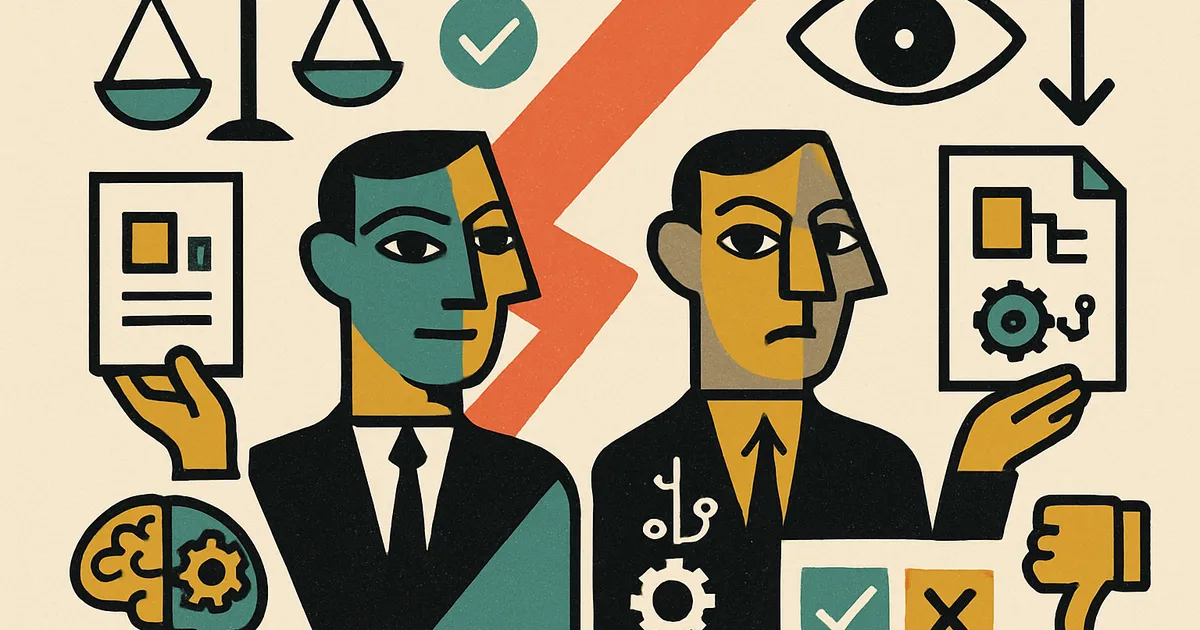
Multiple studies show that workers who use AI are judged as lazier, less skilled, and more replaceable — even when their output is identical. This ancient cognitive bias is silently crippling AI adoption by driving the most productive behaviour underground.
A travel website returns flight results in under a second. Users don't trust it. The same website, returning identical results thirty seconds later with a visible "searching 100+ airlines" animation, gets higher satisfaction scores. People rate the slow version as more thorough, more reliable, more worth paying for. Harvard researchers Buell and Norton (2011) called this the labour illusion: humans prefer services that display visible effort, even when the outcome is identical.
Consumers pay a 17% premium for handmade goods. Fuchs, Schreier, and Van Osselaer (2015) found that buyers perceive human effort as literally imbuing products with love. In separate experiments, Kruger and colleagues (2004) showed participants identical paintings and told them one took four hours and the other twenty-six. Participants rated the twenty-six-hour painting as higher quality and assigned it greater monetary value. Same canvas, same brushstrokes. Different story about how hard it was.
Three findings from three research teams across two decades. One mechanism: humans evaluate perceived effort, not output, and use it as their primary proxy for quality, skill, and care. The effort heuristic is not a quirk. It is load-bearing infrastructure in how we judge competence.
Now hand everyone a tool that makes effort invisible.
The penalty
A 2025 study from Duke's Fuqua School of Business, published in Management Science, ran four experiments with over 4,400 participants. People who used AI to complete work were consistently rated as lazier, less competent, and less diligent than those who received identical help from human colleagues. The output was the same. The ratings were not. The penalty held regardless of age, gender, or occupation. In hiring simulations, managers who didn't personally use AI were less likely to hire candidates who reported regular AI use.
Separately, Johns Hopkins researchers studied 276 practising clinicians and published the results in npj Digital Medicine. Physicians who used generative AI as a primary decision-making tool were rated 3.79 out of 7 on clinical skill by peers, compared to 5.93 for physicians making the same decision without AI. A two-point gap from mentioning the tool. Using AI only for verification partially recovered the score to 4.99, but the stain remained.
The effort heuristic plus the labour illusion plus AI's invisible effort produces what I'd call the competence penalty. AI doesn't remove effort. It removes the appearance of effort. To the human brain, these are the same thing.
The hiding
Workers have noticed. An Anthropic study of 1,250 professionals found that 69% of the general workforce and 70% of creative professionals report social stigma around AI use at work. A UK survey found that a third of workers don't tell their managers they use AI tools, fearing their competence will be questioned. A Pluralsight survey of 1,200 tech workers revealed the mirror image: 79% admitted pretending to know more about AI than they actually do, with 91% of C-suite executives being the worst offenders. And 61% said using generative AI for work is seen as lazy at their company.
Workers are simultaneously expected to embrace AI and punished for being seen to use it. So they use it in secret.
The weavers
The Luddites of 1811–1816 were skilled textile artisans, not technophobes. Their wages and social position depended on visible craft expertise. The power loom erased the visible skill that was the basis of their identity and economic standing. Hand weavers who once earned a day's wages for a day's visible craft found themselves earning in a week what they'd previously earned in a day. The economic loss was real, but the status loss was what drove them to smash machines.
Accountants resisted spreadsheets for the same structural reason. Not inaccuracy. Spreadsheets made the painstaking calculation work that signalled competence disappear.
Professional identity is a receipt for effort spent. AI voids the receipt.
Shadow channels
Hidden tool use has a name in enterprise IT: shadow AI. Nearly 47% of generative AI users access tools through personal accounts, bypassing enterprise controls entirely. IBM's 2025 Cost of a Data Breach Report found that one in five organisations experienced a breach due to shadow AI, with high shadow AI usage adding an average of $670,000 to breach costs. Only 37% of organisations have governance policies in place.
The competence penalty doesn't slow adoption. It redirects adoption into ungoverned channels.
The same dynamic may help explain a puzzle in the adoption data. MIT's 2025 Nanda study found that 95% of generative AI pilots fail to produce measurable financial impact despite $30–40 billion in enterprise investment. If workers are hiding their most productive tool, organisations cannot see the returns — and unmeasurable returns look identical to no returns.
The cycle
The mechanism is self-reinforcing. The competence penalty drives hiding. Hiding creates shadow AI. Shadow AI creates security breaches and unmeasurable ROI. Failed pilots become evidence that AI doesn't deliver, which justifies the stigma that caused the hiding. The cycle tightens.
Most commentary on AI adoption failure focuses on technical readiness, training gaps, and change management. Almost nobody is discussing the fact that evaluation systems themselves penalise the behaviour organisations are trying to encourage. This is a principal-agent problem wearing a lanyard: the organisation wants adoption, but employees face individual incentives to conceal it.
Effort as identity
The deeper issue runs past corporate culture into something structural about how civilisations organise themselves. For most of human economic history, effort and output have been coupled tightly enough that using effort as a quality signal worked. The watchmaker's skill was visible in the hours at the bench. The surgeon's competence was legible in the years of training. The lawyer's value was embodied in the billable hour. Effort was not merely a proxy for quality. It was the foundation of professional identity, social status, and economic reward.
AI decouples effort from output more completely than any previous technology. A factory robot replaces physical labour but does not make the engineer's design work invisible. AI replaces cognitive effort and makes it vanish. The knowledge worker who produces excellent output in minutes with AI assistance looks, to every evaluation system humans have built, like someone who didn't try.
Compensation structures. Promotion criteria. Peer review. Academic tenure. Professional licensing. Social respect. All calibrated to visible effort. All quietly broken by a tool that makes effort disappear.
What breaks the cycle
Meta has announced that AI-driven impact will become a core performance metric starting in 2026. Right direction. But changing a line on a performance review template does not rewire a heuristic that has been functional for millennia. If middle management still pattern-matches on effort signals, the policy is wallpaper.
The organisations that break through will make AI use visible and valued, not merely permitted. Shared prompt libraries. Workflow improvements that propagate across teams. Public recognition for effective AI-assisted work. The goal is to create a new form of visible effort: the skill of directing AI well, made legible to colleagues and managers.
The gap will compound. Hidden tool use means no shared learning, no accumulated institutional knowledge about effective workflows, no feedback loops. One organisation learns in public. The other learns in secret. After two years, they operate in different centuries.
If you are building enterprise AI tools, the uncomfortable implication is this: if your users are hiding the fact that they use you, your adoption metrics are fiction. Usage dashboards cannot see personal accounts. NPS surveys are worthless if respondents won't admit to using the product. The entire feedback loop is broken by a stigma the tool didn't create and cannot directly fix.
Whether organisations redesign their evaluation systems before shadow AI redesigns their risk profiles is not a technology decision. It is a bet on whether a heuristic that has served humans well for a hundred thousand years can be overridden by a slide deck and a quarterly OKR.