
The one-user app
AI will not collapse software into one chat box. It will make software personal, letting people build small tools around edge cases too narrow for any product roadmap. The biggest software market may not be the next billion-user app. It may be the billion one-user apps.
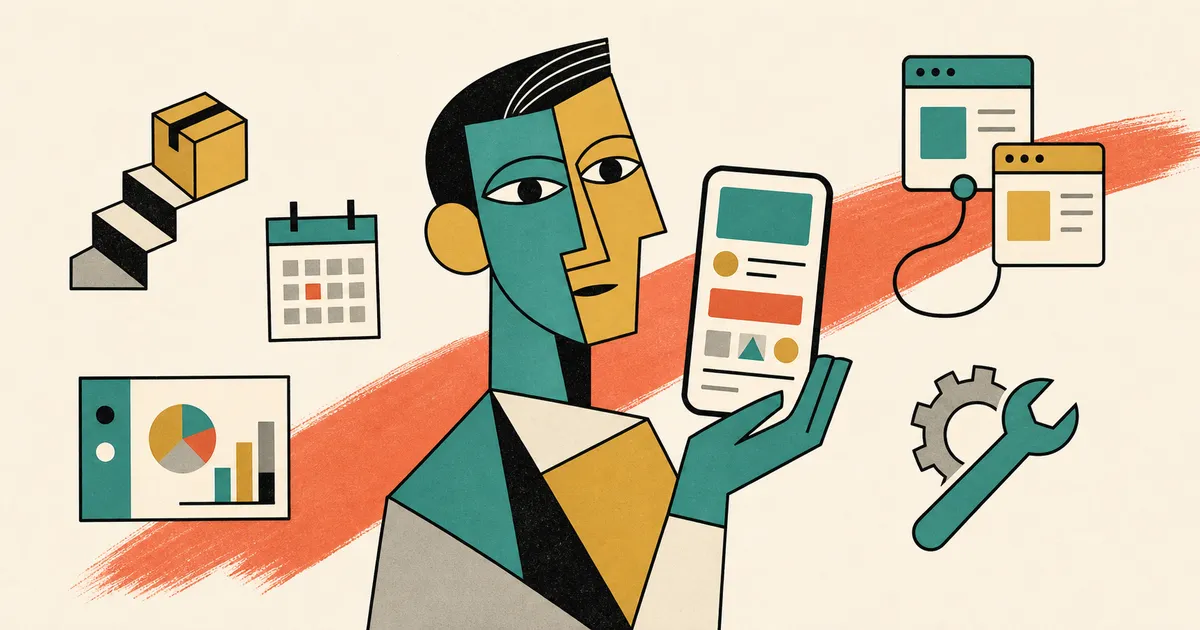
A tool that tracks which of 102 stairs a delivery landed on is a terrible startup and a perfect product.
That example appears in David Pierce's piece on personal software, alongside migraine trackers, trip planners, family tools, fantasy baseball scripts and tiny utilities built for an audience of one. None of these would survive a venture pitch. Most would not justify a meeting on a product roadmap. They are too specific, too odd, too low-margin, too attached to one person's life.
That is exactly why they matter.
The mistake in the "AI will eat software" argument is assuming that if a chat box becomes more capable, the rest of software disappears behind it. You open ChatGPT or Claude, ask for what you want, and the app layer quietly dies. Nice theory. Delete Chrome, then. Delete your calendar, bank app, email, notes, spreadsheet, music app, code editor, CRM, design tool and every dashboard your work depends on.
You will not, because the assistant has not replaced software. It has changed what software is allowed to become.
Software built for averages
Most software is designed around an imaginary average user. Product teams interview customers, cluster needs, prioritise features, argue about edge cases, then ship something coherent enough for a market. That is the right discipline for public software. If Todoist, Notion, Figma or Stripe built every feature every user requested, the product would collapse under its own kindness.
The result is a familiar irritation: every app is nearly right.
Your calendar almost fits your day. Your notes app almost matches how your memory works. Your budgeting tool almost understands your household. Your CRM almost maps the real relationship between customers, friends, favours owed, introductions made and people you should have replied to three weeks ago.
The missing 5% is where the anger lives.
For decades, that 5% was below the economic threshold of software. Too small for a company. Too fiddly for a contractor. Too boring for a startup. Too personal for a product manager. So people built workarounds: spreadsheets with cursed formulas, Apple Shortcuts that break after an update, Notion systems with more architecture than use, screenshots sent to yourself, WhatsApp messages used as databases, browser tabs acting as memory.
AI changes the threshold. It does not make every person a professional software engineer. It gives more people the ability to express a need clearly enough that a system can make something useful from it.
That is a different claim, and a stronger one.
The chat box is not the product
Marc Andreessen's original software thesis was not that one app would win. It was that more industries would become software-shaped. Retail, media, finance, logistics, agriculture, education and defence would all be reorganised around code, networks and online services.
AI pushes the same process into smaller spaces.
When the cost of building software falls, demand does not shrink. It expands into places that were previously too small to count. The family rota. The invoice-chasing script. The browser extension that fixes the one maddening field in the SaaS tool you use daily. The dashboard for house repairs, subscriptions, car maintenance and school emails. The connector between voice notes, screenshots, calendar events and tasks.
The future is not one app replacing everything. It is one conversational layer sitting above millions of specialised tools, agents, workflows and personal interfaces.
OpenAI is already behaving this way. Its apps inside ChatGPT launched with partners including Booking.com, Canva, Coursera, Expedia, Figma, Spotify and Zillow, plus an Apps SDK so developers can build more. That is not the death of apps. That is a new container for apps.
The technical plumbing tells the same story. The Apps SDK builds on Model Context Protocol because assistants need structured ways to connect with data, tools and workflows. Once you admit that, you admit the whole boring substrate: authentication, permissions, state, sync, data models, audit trails, payments, observability, support and failure handling.
A chat box can start the work. Something still has to do the work.
The one-user market
The biggest software market may not be the next billion-user app. It may be the billion one-user apps.
That sounds absurd if you measure software only by revenue. It makes sense if you measure it by irritation removed.
Personal software has different economics. It does not need a total addressable market, a pricing page, an onboarding funnel or a support team. It only needs to be useful enough to justify its existence for the person using it. A tool that tracks a migraine pattern, allocates Secret Santa pairs, turns screenshots into expenses, links WhatsApp messages to a shared calendar or records where parcels land on a staircase can be a bad business and a good piece of software.
Most of these tools will be small. Some will be temporary. Some will run locally and never leave a laptop. Some will be wrappers around existing apps. Some will be half spreadsheet, half script, half shame. That arithmetic is wrong, but so are most useful personal systems.
The important shift is agency. People stop waiting for a product roadmap to notice the corner of their life that does not scale.
This is the old spreadsheet lesson, updated. Spreadsheets turned millions of people into informal programmers without making them software engineers. They let accountants, operators, analysts, founders and bored office managers build tiny systems around their own work. AI-assisted software does the same thing with more surface area: interfaces, APIs, automations, local apps, private dashboards, connectors and agents.
Nobody called the spreadsheet the end of software. It became one of the ways software spread.
Professional developers move up the stack
The obvious objection is true: personal software is brittle.
A tool you build for yourself does not come with a security review, a service-level agreement, accessibility testing, a support queue, regression tests or a team on call. It may fail the moment an API changes. It may leak data if you wire it badly. It may solve the wrong problem because users are excellent at describing pain and often poor at designing systems.
That limit matters. A marketing team should not vibe-code payroll. A small business should not replace accounting controls with a script nobody understands. A public product cannot treat "it works on my laptop" as an operating model.
Professional developers do not disappear in this world. They move up the stack.
They build the primitives that make personal software less dangerous: login systems, sync engines, permission models, deployment rails, integration layers, component libraries, testing harnesses, review workflows and templates that encode good defaults. They build the boring parts once so other people can safely shape the last mile.
That is the commercial opportunity for product companies too. The winning apps will not ask every user to reimagine everything from scratch. Defaults still matter. Most people keep them. But the best products will make the edges malleable: a user can say "make this bigger", "combine these two views", "send this to my partner every Friday", "hide that field", "turn this email into a task only when it contains an invoice".
The product is no longer only the interface the company shipped. It is the set of things the user is allowed to change without breaking the system.
Software gets closer
Robin Sloan's old phrase, "home-cooked software", works because it removes the wrong status game. People do not learn to cook only to become chefs. They cook because they want to feed themselves, save money, care for someone, preserve a habit, improvise around what is in the fridge or make the thing exactly how they like it.
Software has been oddly denied that domestic layer. We accepted a world where companies made the tools and users adapted themselves around them. AI loosens that arrangement. Not completely, and not without risk, but enough to matter.
The one-app argument feels thin for the same reason. A single assistant may become the place where more work starts. It will not become every ledger, file, playlist, booking system, design canvas, calendar, permission boundary, workflow and personal preference. Those systems remain. More of them will appear.
Software ate the world by turning industries into code. AI makes software hungry for smaller prey: the errand, the habit, the family routine, the annoying admin loop, the private dashboard, the missing button, the awkward little corner no product team will ever prioritise.
AI will not eat software. AI will make software ravenous.
Software ate the world. AI is how software starts eating yours.