
Your AI can't use what was never written down
Eighty percent of what runs your business has never been documented. AI forces that knowledge debt to come due — and the 95% pilot failure rate is the invoice.
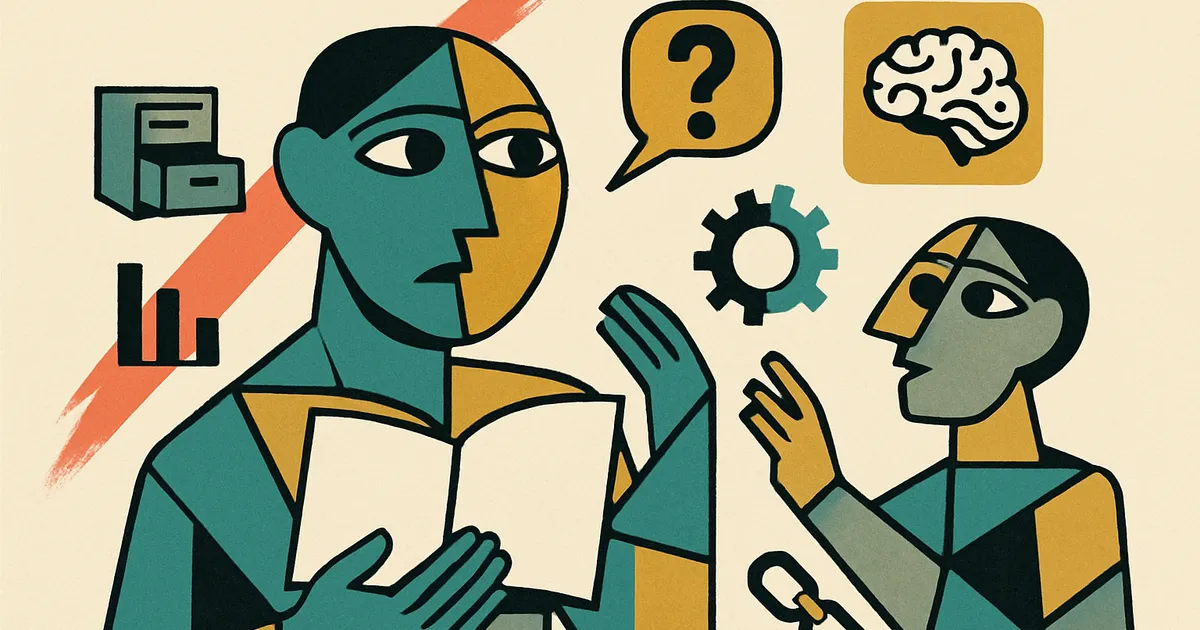
Enterprise generative AI has absorbed $30–40 billion in investment. MIT's 2025 State of AI in Business report puts the failure rate at 95%. Not 95% of startups. 95% of enterprise pilots, inside organisations with budgets, teams, and executive sponsorship, fail to deliver measurable ROI.
The standard explanation points to technology gaps: models hallucinate, integration is hard, data pipelines are immature. But the 5% that succeed aren't using better models or bigger budgets. MIT calls it the "GenAI Divide." What separates winners from the other 95% is systems that learn from feedback, retain context, and adapt to workflows. Systems that can access and build upon institutional knowledge.
The industry has a technology diagnosis for what is actually a knowledge debt problem: the accumulated cost of everything your organisation knows but has never written down. AI is forcing that debt to come due.
The invisible 80%
Roughly 80% of an organisation's intellectual capital is undocumented tribal knowledge. 90% of enterprise data remains unstructured and siloed. These numbers, from Valere.io research corroborated by IDC, describe a reality any experienced operator recognises: the knowledge that actually runs your business doesn't live in your systems.
How is churn calculated? Depends who you ask. How do sales territories actually work? Three different answers on the same floor. Why does one product line get different treatment from procurement? Because of something that happened in 2019 that only Sarah knows about.
Business logic (the real kind, not what's in your documentation) lives in Jira tickets, PowerPoints, email threads, Slack messages, and most critically, in the heads of experienced employees. InfoWorld's analysis calls this "policy plus process plus history": seven-step workflows requiring judgment and institutional memory, invisible to system logs and standard documentation. When AI hits these situations without decision traces, it either guesses wrong or escalates everything. This is why chatbots handle simple queries and collapse on anything that matters.
Shadow AI tells the real story
IBM's 2025 research found that over 80% of American office workers use AI, but only 22% rely exclusively on employer-provided tools. The rest use ChatGPT, Claude, and other consumer tools on the side. They describe their company's AI as "unreliable" while rating the same underlying technology as effective when used personally.
The difference isn't the model. It's context.
Employees bring their own tribal knowledge to every interaction. They know which customer is price-sensitive, which supplier requires special handling, which approval step can be skipped on Fridays. They provide the institutional context that enterprise systems lack, and the AI performs accordingly. Same model. Different knowledge wrapped around it.
Corporate data shared with AI tools increased 485% between March 2023 and March 2024. Employees are bridging the knowledge gap themselves, often at significant security risk. Shadow AI isn't a compliance problem. It's evidence that your knowledge infrastructure is broken.
Knowledge as coordination infrastructure
Coase argued that firms exist because internal coordination is cheaper than market transactions. Knowledge is what makes that coordination possible. When knowledge is documented and accessible, coordination costs stay low. When it lives in Sarah's head or scattered across inboxes, the coordination cost is human. You need Sarah in the room.
This is why delegation costs don't collapse evenly across an organisation. In departments where processes are explicit, AI can execute at near-zero marginal cost. In departments where tribal knowledge dominates, you're still paying for human presence. The firm boundary doesn't shift until the knowledge shifts.
AI makes this stark. Either your institutional knowledge is capturable by systems, or your costs remain human-scale regardless of how much you spend on models and infrastructure. The bottleneck isn't compute. It's capture.
What happens when you attack knowledge debt directly
The companies crossing from pilot to production recognised this early.
In manufacturing, CADDi documented what it calls the tribal knowledge tax. Engineers at K.T. Seisakusho found it easier to create new drawings from scratch than locate existing ones. Every duplicate part silently added to inventory, QA overhead, and supplier costs. After deploying AI-powered knowledge capture, Kawasaki Heavy Industries cut $20,000+ in annual labour costs from part-search time alone. SUBARU reduced drawing search time by several hundred hours per month. The gains came not from better models but from making previously invisible knowledge explicit.
Skan.ai took a different angle. Their process discovery technology watches actual employee work across applications rather than reading system logs. It surfaced hidden workflows that traditional process mining missed entirely. One enterprise achieved a 40% reduction in process variability and $13.6 million in annual operating cost savings. Same AI capabilities available to everyone. The difference was capturing the knowledge that made those capabilities useful.
The vendor data reinforces the pattern. MIT found that vendor-purchased AI solutions succeed roughly 67% of the time, while internal builds succeed only a third as often. The gap isn't technical sophistication. Specialised vendors have already solved for learning and workflow adaptation. Internal teams consistently underestimate the knowledge-capture challenge, building technology solutions for what is fundamentally an organisational knowledge problem.
The audit before the investment
66% of executives want AI tools that learn from feedback. 63% demand persistent context. They're describing what they need without naming the prerequisite: the knowledge feeding those systems must first exist in a form systems can access.
Before you commission another pilot, audit your knowledge debt:
- Where does undocumented knowledge live in your organisation?
- Who are the knowledge bottlenecks — the people who must be in every meeting because the process lives in their heads?
- Which decisions require tribal knowledge that no system can access?
- How much of your process documentation reflects actual practice versus aspirational practice?
The answers tell you more about your AI readiness than any technology assessment.
The compounding problem
Knowledge debt, like technical debt, compounds. Every month that institutional knowledge goes uncaptured, it becomes harder to extract. People leave. Processes drift. The gap between documentation and reality widens.
MIT's report warns of a narrow 18-month window in many verticals for organisations to lock in compound learning advantages. Organisations that miss it won't be behind on AI adoption alone. They'll be behind on the knowledge infrastructure that makes any future AI investment viable.
The 95% failure rate isn't an indictment of AI technology. It's the invoice for decades of treating institutional knowledge as something that can live in people's heads. The organisations reframing AI adoption as a knowledge-capture programme first, and a technology programme second, are the ones crossing from pilot to production.
The question for everyone else: how much longer can you afford to run on what was never written down?